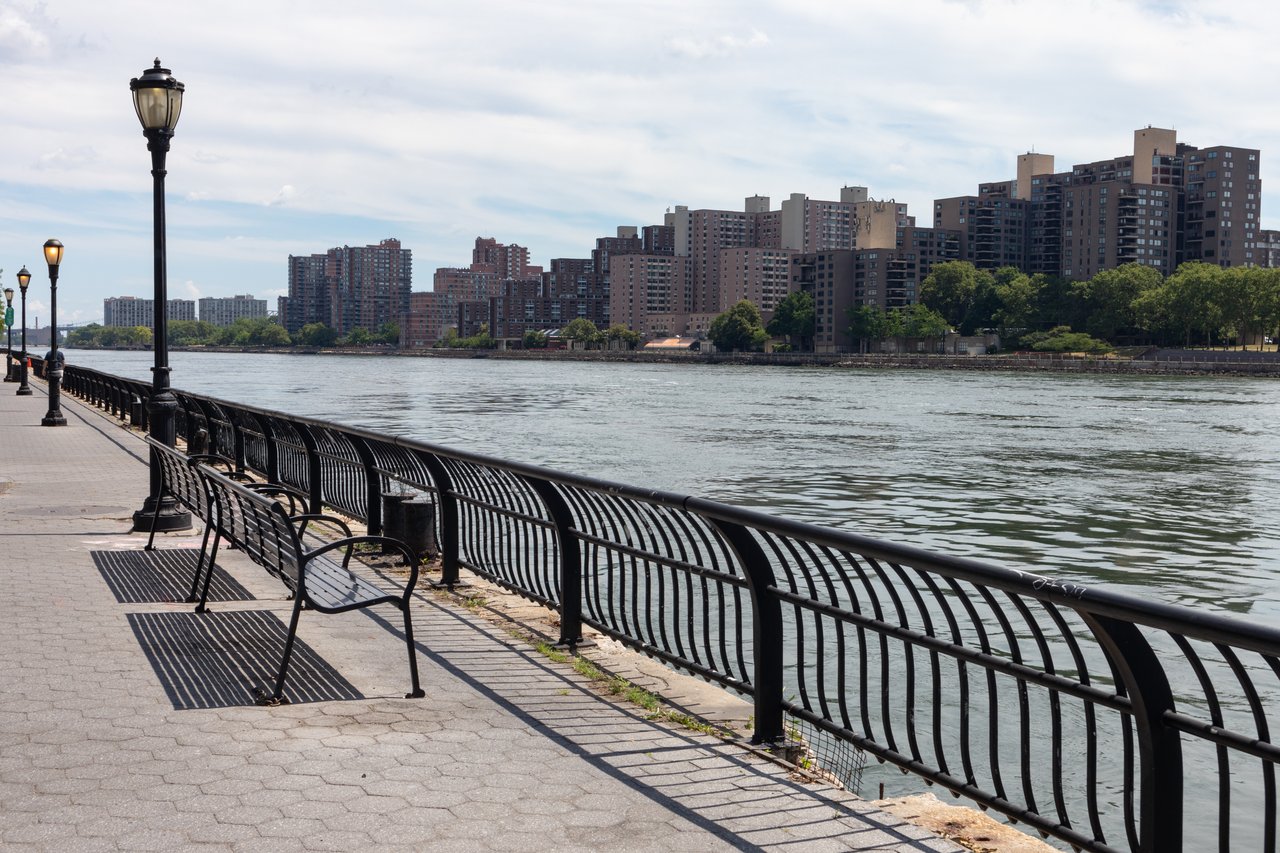
For four years, anyone walking east from Central Park toward the river near East 70th Street has known to expect a fence. The blockade around the East River Esplanade there has outlasted years of stalled construction. This fall, that fence is finally coming down in pieces. At almost the same moment, a different fence goes up a few blocks west, around Central Park's own East 72nd Street entrance, where Conservatory Water and Bethesda Fountain have anchored the neighborhood's outdoor routine for well over a century.
That timing is not a coincidence worth shrugging off. It is the actual story of the Upper East Side's outdoor life this fall: the crosstown band of streets in the low 70s, running from Fifth Avenue through the park to the river, is trading one kind of closure for another. If your regular loop touches any part of that stretch, and on the Upper East Side it probably does, the shape of your walk is about to change on both ends at once.
The Fountain Goes Quiet First
Bethesda Fountain, the 153-year-old centerpiece of Central Park's most photographed terrace, went dark in early August 2026. The Central Park Conservancy announced the closure as part of a $37 million combined investment in the fountain and Conservatory Water, and the fountain itself is now turned off and enclosed in construction fencing for about a year while crews rebuild its mechanical, plumbing, and control systems and restore missing sculptural detail. Bethesda Terrace, the arcade and plaza surrounding it, stays open the whole time, so the wedding photographers and afternoon strollers who use the space will still have somewhere to stand. They just won't have water in the fountain to stand in front of.
The Conservancy frames the work as overdue maintenance rather than a design change, and the timeline backs that up. A fountain that has run continuously since the 1870s needs its internals replaced eventually, and the Conservancy is treating this as a one-year project rather than an open-ended one. For a neighborhood that treats the park as an extension of its own backyard, a year is still a year without one of its most recognizable backdrops.
The Sailboats Lose Their Pond
A short walk north, Conservatory Water at East 72nd Street and Fifth Avenue is heading into a longer disruption. Construction begins in late 2026 and the basin will stay closed through the entire 2027 boating season, with the Conservancy targeting a reopening in late spring or early summer 2028. The concrete basin has been leaking so badly that staff have struggled to keep water levels high enough for the model sailboats the pond is known for, and the fix goes beyond patching the leak. Crews plan to replace deteriorated concrete walls, install a waterproof liner, repair the historic stone steps, and regrade the surrounding paths for better accessibility.
The adjacent Kerbs Boathouse, built in 1954 and never substantially renovated, gets its own overhaul on a parallel timeline, including expanded restrooms, a reworked concession space, and a green roof visible from Fifth Avenue. It is the kind of project that sounds cosmetic until you remember that the boathouse restrooms have not been touched since the Eisenhower administration.
Not everything in that corner of the park goes dark. A few landmarks stay accessible through the work:
- The Alice in Wonderland statue remains open to visitors throughout construction
- Conservatory Garden, a few blocks north, is unaffected
- Bethesda Terrace stays open even while the fountain itself is fenced off
- Rowboat rentals continue at Loeb Boathouse on the Lake, on the park's west side, for anyone who wants water access while Conservatory Water is offline
That last point matters more than it sounds. It means the park is not closing, exactly. Two specific, beloved features of it are, for a specific and unusually long stretch of time.
The River Path That Finally Catches Up
Meanwhile, the East River Esplanade behind the Hospital for Special Surgery is finally moving in the other direction. That stretch, between East 70th and East 78th Streets, has been blocked off since 2022 while HSS built an addition and prepared to privately fund the Esplanade's restoration once construction wrapped. For years, park users walking north had to leave the Esplanade at East 71st Street, cut over to busy York Avenue, and rejoin the path eight blocks later at East 79th.
That detour is finally shortening. HSS project representatives told Community Board 8 in March 2026 that the corridor is reopening in phases, with the goal of a full reopening by the end of October 2026. It has taken four years to get here, and the timeline has slipped before, so treat "by October" as a target rather than a guarantee. But for a stretch of waterfront that has been effectively erased from the neighborhood's mental map since 2022, even a phased return changes how people plan a run or a stroller loop.
The Esplanade had a separate scare of its own this spring, unrelated to the HSS work. A long-standing sinkhole between East 93rd and East 94th Streets widened suddenly in April 2026, forcing an emergency closure that disrupted commutes to the East 90th Street ferry dock and to nearby schools. The city fully shut a three-block stretch between East 93rd and East 96th Streets starting May 26 for repairs, with Friends of the East River Esplanade's Maria Kessler warning at the time that the closure would hit students and faculty traveling to and from school while classes were still in session. By early July, the fix held and the path reopened in time for the Fourth of July weekend, and has stayed open since.
Two different problems, two different timelines, one shared lesson: this waterfront is nearly a century old in places, and its infrastructure fails in patches rather than all at once.
Same Streets, Trading Places
Line up the two stories and the coincidence is hard to miss. The stretch of the Upper East Side that runs from Fifth Avenue at 72nd Street, through the park, to the river around 70th to 78th, is experiencing a closure and a reopening on almost the same calendar. Conservatory Water and Bethesda Fountain, both untouched by the kind of decay that plagued the Esplanade, are entering their first major closures in decades. The river path a few blocks east, blocked since 2022, is finally being handed back.
For someone whose regular walk runs crosstown along 72nd or 76th Street, that means the character of the route flips without the total mileage necessarily shrinking. The park end gets quieter and more fenced-in. The river end, after four years of forced detours onto York Avenue, gets its continuity back. Neither change is dramatic on its own. Together, they mean the walk you've been doing for years will feel different by winter, not because less of it is open, but because the closed and open segments have swapped places.
That is worth knowing not because it should change anyone's plans, but because it is the kind of detail that separates a resident who reads the neighborhood closely from one who only notices construction fencing after walking into it. Community Board 8 has been tracking both projects, and the Conservancy and Friends of the East River Esplanade have both said they will post updates as work progresses. If a specific block matters to your routine, whether it's the fountain you pass on a run or the ferry dock you catch at East 90th Street, it is worth checking those updates directly rather than assuming last month's map still holds.
None of this is a reason to see the neighborhood as under siege. Century-old parks and century-old waterfronts require this kind of periodic, overlapping repair, and the Upper East Side has absorbed worse disruptions than a rerouted jog. What it does mean is that the next few months are a genuinely unusual moment for anyone who treats these blocks as home rather than scenery. The map is being redrawn on both ends of the same corridor at once, and it will settle into a new normal before most other things about the neighborhood do.
If you're weighing what a home near this stretch of the Upper East Side is actually worth to you, whether that's proximity to the park, the river, or both, Patricia Levy has spent more than two decades tracking exactly this kind of block-by-block detail. Let's Connect.